

Raw and Real Conversation
No matter what you and I do, we all get into meetings for our work.
What makes me wonder, is how many of those “important work meetings” are really important?
At least once a week I will get a DM with something like, “I need your help. Can we get on a quick call please?”
My response is, “Happy to help. Could you send me an email? Here is my email ID.”
99% of the times the email does not arrive.
This double whammy of human beings’ eternal love for infinite meetings and the extraordinary optimism to take on the world with the solutions we will have through “a quick call” never ceases to make me wonder.
But here I am to tell you, that having too many meetings is ruining your productivity, your creativity, and also your overall well-being.
The last thing you signed up for, when you signed up for your work.
How are too many meetings are ruining your productivity?
Here is how:
1. Meetings reduce your focus.
In a meeting, you are speaking and/or listening. You are discussing but it is not moving any needle forward. It not only visibly takes away your time to do meaningful work, it also reduces your energy to focus because you have expended that energy on a meaningless task already.
It is like Anushka asking Virat when he has already secured 90+ runs in an inning, about what furniture they want for their bedroom. Important question, but absolutely diverging from the focus at that time. It’s sad as a nation we understand and respect Virat’s focus, yet slaughter our own almost every day without even being aware of it.
2. Meetings interrupt a flow of work.
Let’s say you have blocked 3 hours on your calendar to work on an important report. And then you receive a ping from an important client for “getting on a quick call.” Let us say the call lasts for 10 minutes. But you are not back to focus immediately. Here is an insight about “first awkward 30 minutes” btw.
Also, unless you are a medical doctor, not all calls to be attended immediately. I am in year 11 of my work but I was like this in year 1 of my work too, despite my boss thinking he “needed to be available always”. My bonus was skyrocketing in that year too.
3. When you won’t have so many meetings, you will leave work on time.
That in itself is an insult for so many people. Leaving work late is an honour most of us quietly carry. It is a badge that we think that will yield us more respect and love from others.
Little do we realise the only thing that leaving late gives you is bigger body (because you will now have dinner late), little to no time to spend with yourself and of course, going to bed late, thus, leading to waking up groggy the next morning. The dominoes is so massive that we even stop thinking about it.
Why do we get into so many meetings?
We will get to how to reclaim your time from meetings in the later part of this article, but before that we need to get into why people even get into so many meetings in the first place, even sometimes against their own will. Here is why:
1. We don’t know what to do when we get bored.
So we subconsciously fill all our time with meetings. Parkinson’s Law states that work expands or contracts in proportion to your time. So if you have an entire working day of 8 hours with you but the work is for 3 hours only, your mind will manufacture meetings or figure how to be wasted on the internet, before finally getting to work in the final 3 hours.
Most people have no idea what to do when there is no work. Whether it is 5 hours or the 2 days of the weekend.
2. We all like feeling important.
When we are in a meeting, we are either making our juniors listen to your blabbering, or we are listening to a senior’s blabbering. Both useless, yet we collectively feel important.
It is a fake sense of importance, but a human caves in for fakeness only when it cannot give itself the real one. Which brings me to the next point, i.e., we all have no idea how to make ourselves feel important.
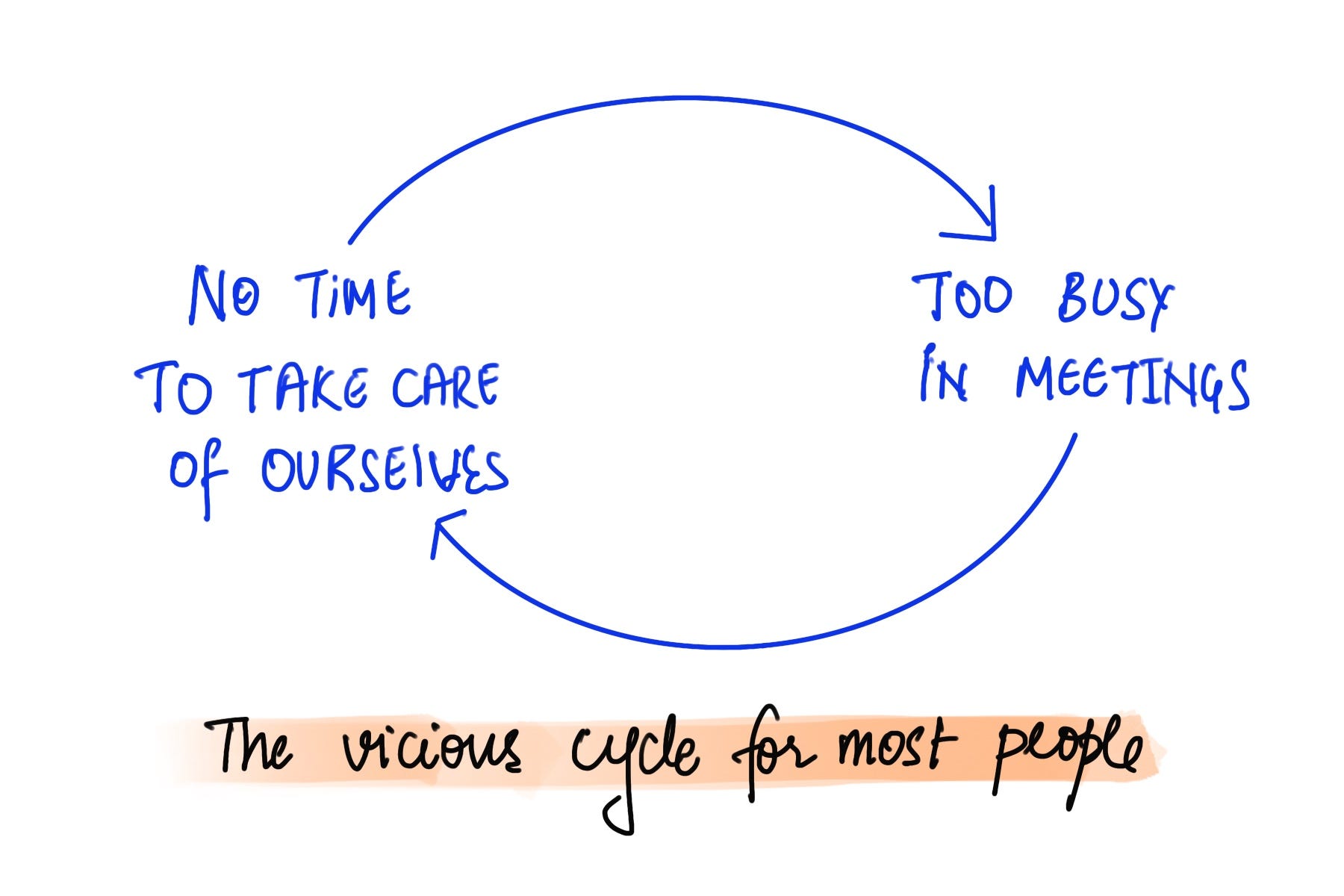
3. We don’t take care of ourselves/treat ourselves like the most important person.
Few ways to take care of ourselves are working out, meditation, reading good books, spending time alone (sans phone), going for a long walk, etc., which most of us are too busy to take time out for. At this point do you want me to say where we are even busy? :)
4. Human brain is designed to take things out.
When Ed Sheeran was writing “Shape of you”, which is one of the top 10 viewed songs on YouTube EVER, it was his usual days of going to the studio from 9 am to 5 pm, and writing songs. He often talks about how the first few songs are not worth it, but when the pipe is clear, good stuff emerges. “Shape of you” was the third song of the day, and most people in the world know Ed only by this song.
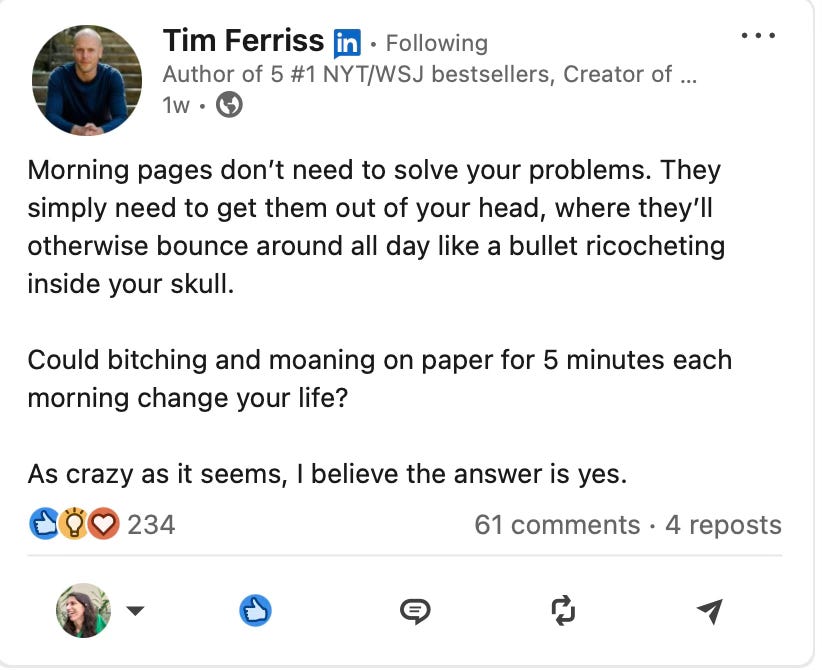
For you and I, what it means is we do “morning pages”. In her remakable book “The Artist’s Way” Julia Cameron talks about writing all that is on your mind for 3 pages straight. Even when you have nothing to write, write “I have nothing to write.”
Tim Ferris, who is the author of 5 NYT bestsellers, goes on to say this about morning pages:
5. Lack of responsibility.
“Hey let’s get on a quick call because I cannot take out 5 minutes out of my time to write 2 sentences coherently on an email so I better blabber 20 sentences to you over a short 10-minute call, and then you go figure.”
It makes me sad so many people live their years in this trap unless they realise the value of their time (and energy and focus).
Let me tell you a secret btw:
No matter what you do, no one has this much work that they are always busy. After 3-4 hours of meaningful work, everyone is pretending, mostly without being aware of it.
But our own company scares and scars us so much that we meaninglessly meander around in meetings. Please don’t do that to yourself.
When is it ideal to have meetings?
Does all of the above conversation mean that we should stop having meetings altogether?
Ah, what an ideal world. <3 We are creating, sending emails, closing things, and having conversations just to chill out or for tea but never to blabber. What an ideal world…
That said, of course you should have some of those meetings, such as:
1. Where we haven’t gotten to a conclusion after 4-5 email/text exchanges. It does circle back to “lack of responsibilty to coherently type an email” but it is up to you to learn to communicate effectively. This article from Wes Kao, or her newsletter in general is great help in formal, real, get-to-the-point-politely communication.
2. I usually get clear on the agenda before the meetings + also ask the other person, “what needs to happen in the meeting for us to have a successful one”? This reduces meetings by 50% by clearing agenda on the email, remaining 30% have clarity on agenda, and the 20% that get angry and run away, I am glad because I do not have to waste my future time on meaningless meetings with them.
Before we move on to the last part, hand on heart, do you not think that 60-70% of the meetings could have been an email?
If you think so too, here is how we are going to fix our incessant urge for meetings:
What do we do now?
1. Firstly, figure out what non-screen activity would you do when you have nothing to do. It has got nothing yet everything to do with meetings.
Some things on my list are obviously walking, cleaning bookshelf, cleaning kitchen (while listening to an inspirational YouTube video on speaker), reading, looking out of the window, or even making notes for an article like this.
But to have a business out of your core business is the only way to sanity in 2025.
If you won’t have these, you will automatically attract more merciless meetings into your life. Phew.
2. First two hours of your working day, no meeting.
Get your most important thing done, that clearly shows progress to you. It only takes courage to say, “Hey, could we move our meeting to 12 instead of 9.30?” At least 2-3 days of the week if not all.
3. Get into every meeting with an agenda.
If you are a senior, people would respect you for not wasting their time. If you are a junior, people will respect you for respecting your time.
4. Each time you have the urge to say “Let’s get on a quick call”, take out 5 minutes with yourself and write that coherent email. Don’t be so cheap that you are always reachable.
5. Schedule at least one of the above activities in point 1 in your calendar next week. Talk is cheap, doing is what moves the needle. Protect your Sundays at all costs and do things that aren’t “productive” to actually do productive things during working days.
I get it that today’s entire article was a bomb.
But my friend, 2025 went away in a wisp and most of us do not even know where it went. We all know now where it went — in meetings giving importance to people who never gave themselves any importance, and of course screen.
In 2026, you claim your time back from both of these.
If we want to get to a magical 2026, it won’t just happen by making New Year Resolutions that will go away by max January 8th, it would happen by getting out of our own way (and most meetings).
I know you can. We all can. We all must. We will.
2 Raw One Liners:
We all would do so well if we stopped having opinion on things that we cannot change.
All you have is your energy. People know what you bring to the table even before you bring yourself to the table.
3 (for) Real books you could pick this vacation that have at least changed my life (and would change yours too):
The Artist’s Way, by Julia Cameron: Even if you pick up the “morning pages” from that book, it would be so so useful.
The Magic of Thinking Big by David Schwartz: Books like these are not written anymore. To the point. In short chapters. Filled with big changes.
Quit by Annie Duke. In a world that says “winners don’t quit” this book helped me the most when I needed to quit.
At the end, I really hope this article helps you make one small change in your relationship with meetings. And with yourself too.
I will see you next week my friend. WIth something lighter, I promise. <3
Loads of love for reading this long newsletter :))
Nishtha Gehija
LinkedIn | X | Daily blog | Weekly newsletter
Instantly access my ebooks:
20s versus 30s: The strange and unique differences between the two most important decades of your life
The Corporate Life Handbook: If you are in corporate job and struggle with daily humdrums of it, one-pagers with harsh truths are something no one is going to tell you :)
The Career Changing Guide: If you are looking for a sign, this is it :)
How to Deal with Heartbreak: A book almost everyone needs but no one gives you right in your hand. If you don’t need this, get this for a friend you know certainly needs it.
Every Writer Needs to Read this: A book I wish I had 11 years ago when I was starting out as a writer
Totally feel this. Running multiple teams taught me the same thing- every unnecessary meeting steals more energy than time. You lose the rhythm you actually build companies with. A polite “email works better for me” saved my sanity. 🙂
The part about asking people to send an email instead of jumping on a call is so simple but most folks don't do it. That 99% stat about emails never arriving actually checks out, because if someone can't take 2 minutes to write out their question, they probably don't have their thoughts organized enough to make a call productive anyway. It's wild how we all collectively agree to burn time in meetings instead of just being straight with each other.